

Leyrand Law Firm
Tanzania is one of East Africa's most dynamic trading economies — rich in agricultural commodities, minerals, and manufacturing potential. Yet thousands of businesses cannot access the financing they need to trade competitively. The reason is not a lack of opportunity. It is a lack of access to the right legal and financial instruments.
- USD 1.3B — annual trade finance gap in Tanzania
- 90%+ — of Tanzanian businesses are SMEs
- USD 92B — Africa-wide unmet demand (2024)
- +89% — intra-African trade growth post-pandemic
What Is Trade Finance?
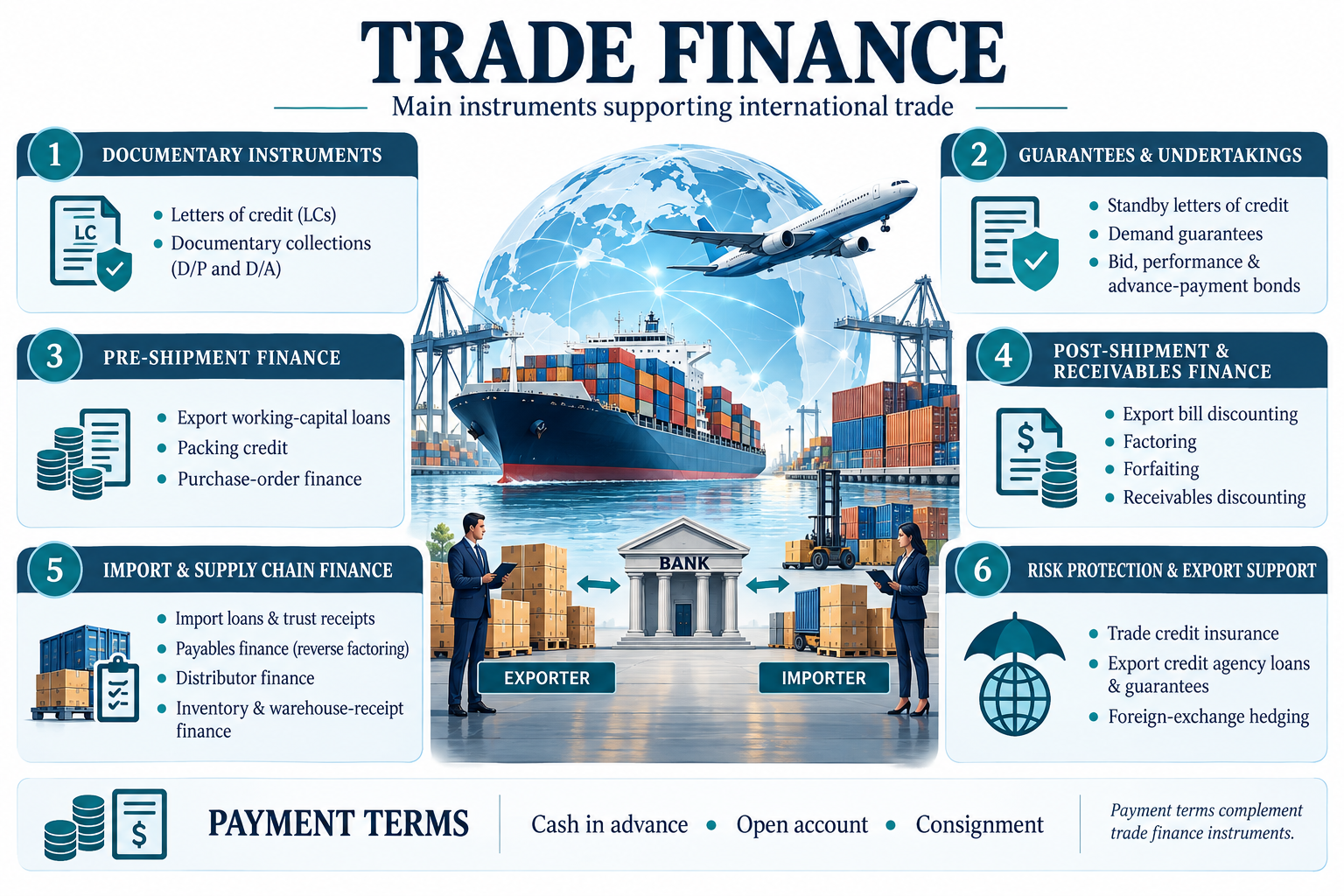
Trade finance refers to the financial instruments, products, and services that facilitate domestic and international trade transactions. At its core, it solves a fundamental problem: the gap between when a seller needs payment and when a buyer is ready to pay.
For exporters, trade finance provides payment security before goods are shipped. For importers, it provides the ability to receive goods before funds are fully disbursed. For banks and financial institutions, it is a mechanism to manage risk across borders. For governments and development institutions, it is a tool to stimulate economic growth.
According to the International Trade and Forfaiting Association (ITFA) and Trade Finance Global, trade finance underpins approximately 80–90% of global trade — making it the invisible backbone of the world economy. When businesses cannot access it, they cannot compete internationally.
Core Trade Finance Instruments
Understanding the available instruments is the first step to accessing them. Each carries different risk allocations, documentation requirements, and regulatory implications under Tanzanian and international law.
Letter of Credit (LC)
A bank-issued guarantee that payment will be made to the exporter upon presentation of compliant documents. Governed by UCP 600 rules. The most widely used instrument in Tanzania's import sector.
Bank Guarantees & Bonds
Issued by a bank on behalf of a client to secure performance, advance payment, or tender obligations. Governed by URDG 758. Critical in infrastructure and government contracts.
Documentary Collections
The seller's bank forwards trade documents to the buyer's bank, which releases them against payment or acceptance. Lower cost than LCs but with less payment protection.
Supply Chain Finance
Working capital solutions that free up liquidity trapped in receivables or payables. Allows buyers to extend payment terms while suppliers receive early payment.
Invoice Discounting & Factoring
Businesses sell unpaid invoices to a financier at a discount to unlock immediate cash flow. Particularly relevant for Tanzanian exporters with long payment cycles.
Commodity Finance
Structured financing for agricultural and mineral commodity traders — covering coffee, cashew, cotton, gold and more. Afreximbank and commercial banks are active in this space in Tanzania.
Tanzania's Trade Finance Landscape in 2026
Tanzania is a resource-rich economy and a gateway to the East African Community (EAC) market of over 300 million people. Key export commodities include coffee, cashew nuts, cotton, gold, tobacco, and horticultural products. The country is also growing as a manufacturing and logistics hub, positioned between the port of Dar es Salaam and landlocked neighbouring markets.
Yet despite this strategic position, Tanzania's trade finance sector faces a structural access problem. SMEs — which make up over 90% of Tanzanian businesses and contribute approximately one third of GDP — are largely excluded from formal trade finance facilities due to collateral requirements, documentation gaps, and limited banking relationships.
SMEs and corporates are vital engines of industrialisation, innovation, and job creation — yet a USD 1.3 billion annual trade finance gap continues to hold them back.
— AfDB, Tanzania Trade Finance Guarantee Facility, 2025
A landmark intervention came in September 2025, when the African Development Bank (AfDB) approved a USD 10 million trade finance guarantee facility for Exim Bank Tanzania — providing up to 100% guarantees to international confirming banks against non-payment risks. Key sectors expected to benefit include agriculture, health, energy, and manufacturing through imports of fertilisers, pharmaceuticals, and equipment, as well as exports of coffee, cashew, and cotton.
Challenges & Opportunities in Tanzania
Key challenges
- Limited correspondent banking relationships reducing LC access
- High collateral requirements excluding MSMEs
- Regulatory complexity under Bank of Tanzania (BoT) frameworks
- Foreign exchange volatility impacting import/export pricing
- Low awareness of AfCFTA instruments and trade facilitation tools
- Inadequate documentation standards weakening financing applications
- Risk of correspondent banking de-risking widening the gap further
Opportunities & enablers
- AfDB–Exim Bank Tanzania USD 10M guarantee facility now active
- AfCFTA opening a USD 3.4 trillion continental market
- PAPSS reducing dependence on hard currencies for intra-African trade
- Afreximbank targeting USD 40 billion intra-African financing by 2026
- Digital trade finance platforms reducing documentary barriers
- EAC customs integration streamlining cross-border documentation
- African Union's G20 seat advancing trade finance reform globally
The African Context: AfCFTA, Afreximbank & AfDB
Tanzania's trade finance challenges cannot be understood in isolation. Across the continent, Africa faces a persistent trade finance gap estimated at USD 74–92 billion in unmet demand in 2024 alone — with warnings that tighter correspondent banking risk appetite could widen this to USD 86–102 billion by 2027.
Three continental pillars are reshaping the landscape for Tanzanian businesses:
- African Continental Free Trade Area (AfCFTA): more than a tariff reduction framework — a platform for industrialisation, digital leapfrogging, and market access across 54 nations. Tanzanian businesses with the right corporate and legal structures can now access preferential trade terms across the continent.
- Afreximbank: disbursed over USD 17.5 billion in trade finance in 2024 and is on course to double intra-African financing to USD 40 billion by 2026. Its commodity finance, project finance, and guarantee programmes are directly accessible to Tanzanian businesses.
- African Development Bank (AfDB): the AfDB's Trade Finance Programme has facilitated USD 32 billion annually between 2020 and 2024. Its 2025 report underscores the critical role of DFI support in preventing a wider financing gap — and Tanzania is a direct beneficiary through the Exim Bank guarantee facility.
- Pan-African Payment & Settlement System (PAPSS): enabling intra-African trade in local currencies, reducing FX costs and dependency on hard currencies — a direct benefit to Tanzanian exporters trading within the EAC and wider Africa.
How Leyrand Law Firm Can Help Your Business
Leyrand Law Firm is a Tanzanian corporate and commercial law firm positioned to serve as the strategic legal partner for businesses navigating trade finance. We understand that trade finance is not just a banking question — it is a legal architecture question.
From structuring the right corporate vehicle to drafting watertight LC terms, from regulatory compliance to dispute resolution, Leyrand provides end-to-end legal support that turns trade finance potential into commercial reality for businesses operating in Tanzania and across East Africa.
Our Services: Unlocking Trade Finance for Your Business
Transaction Structuring & Contract Drafting
Draft and review trade finance agreements, LC terms, bank guarantees, commodity finance contracts, and supply chain finance structures — ensuring compliance with BoT regulations and UCP 600/URDG 758 international rules.
Export & Import Regulatory Compliance
Legal advisory on Tanzania's import/export regulatory requirements — TMDA, TBS, TRA compliance, customs law, EAC rules of origin, and the documentation standards needed to qualify for trade finance facilities.
DFI & Bank Facility Negotiations
Support businesses in negotiating with Afreximbank, AfDB partner banks, and Exim Bank Tanzania — reviewing guarantee facility agreements, due diligence documentation, and protective covenants.
AfCFTA Market Access Strategy
Advise on AfCFTA protocols — tariff schedules, rules of origin, trade in services — positioning Tanzanian exporters to access new continental markets under preferential terms with the right legal standing.
Trade Finance Dispute Resolution
Representation in trade finance disputes — wrongful LC calls, payment defaults, cargo disputes, and banking litigation — before Tanzanian courts, ICSID, or ICC international arbitration panels.
Corporate Structures for Trade Eligibility
Establish SPVs, joint ventures, and subsidiaries optimised for trade finance eligibility, FDI compliance, and BRELA registration — ensuring your business structure unlocks rather than blocks financing access.
Ready to Unlock Trade Finance for Your Business?
Contact Leyrand Law Firm for a confidential consultation on trade finance structuring, regulatory compliance, and legal strategy in Tanzania.
Sources & References
- Afreximbank, African Trade Report 2025: African Trade in a Changing Global Financial Architecture, Cairo, June 2025.
- African Development Bank, Trade Finance Report 2026, Abidjan.
- AfDB Press Release, AfDB Approves USD 10 Million Trade Finance Guarantee to Exim Bank Tanzania to Support SMEs and Local Corporates, September 2025.
- Trade Finance Global / ITFA, Trade Finance Guide 2020.